01 / CONSISTENCY
Common-topology rigs
Fitted ICT FaceKit rigs provide accurate, consistent expression targets on a shared topology.
Reliable expressions · template-biased geometryA topology-preserving deformation model trained with complementary mesh and image supervision.
1 Queen’s University2 Pickford AI3 University of Toronto4 Vector Institute
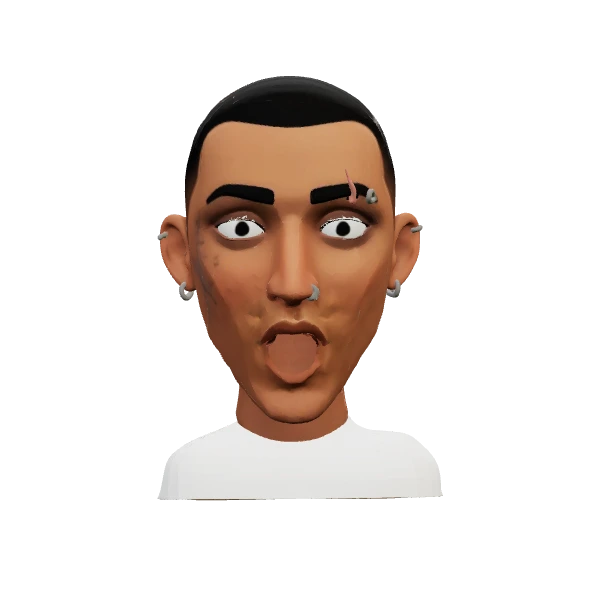
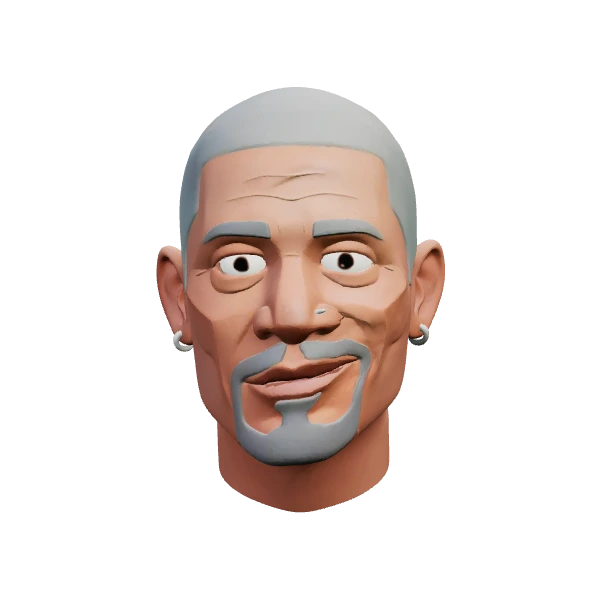

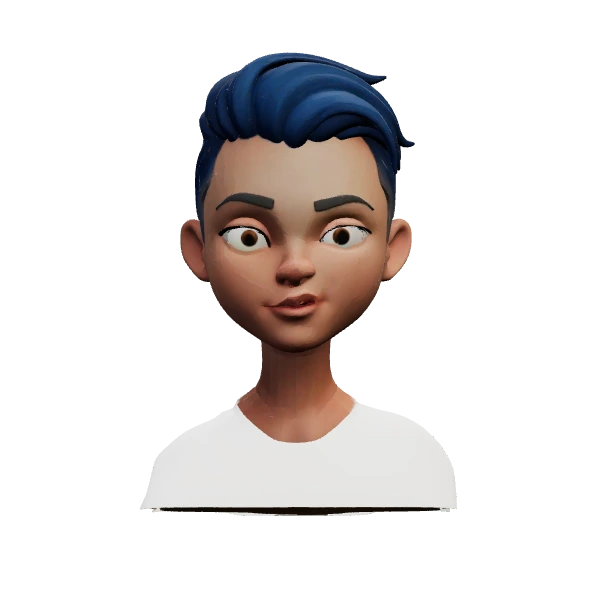
OVERVIEW
Automatic facial rigging across heterogeneous mesh topologies is limited by template-dependent supervision and errors introduced during deformation transfer.
TopoRig predicts action-unit-conditioned displacements directly on the input vertices. The model combines common-topology rigs, transferred custom-topology rigs, and targeted image-based cues to generalize to unseen identities while preserving input connectivity and UVs.
INTERACTIVE VISUALIZATION
Select a sample and expression control.
Adjust its intensity to inspect the deformation.
Separate gaze blendshapes from the sample assets.
These controls are not labeled as facial action units.
THE METHOD
Joint training with common-topology targets,
custom-topology targets, and image-based cues.
Fitted ICT FaceKit rigs provide accurate, consistent expression targets on a shared topology.
Reliable expressions · template-biased geometryTransferred expressions retain each generated character’s geometry and introduce varied mesh connectivity.
Diverse topology · noisier transferred targetsTargeted image supervision refines eight eye-region controls where transferred 3D targets are less reliable.
Localized cues · stronger eyelid closure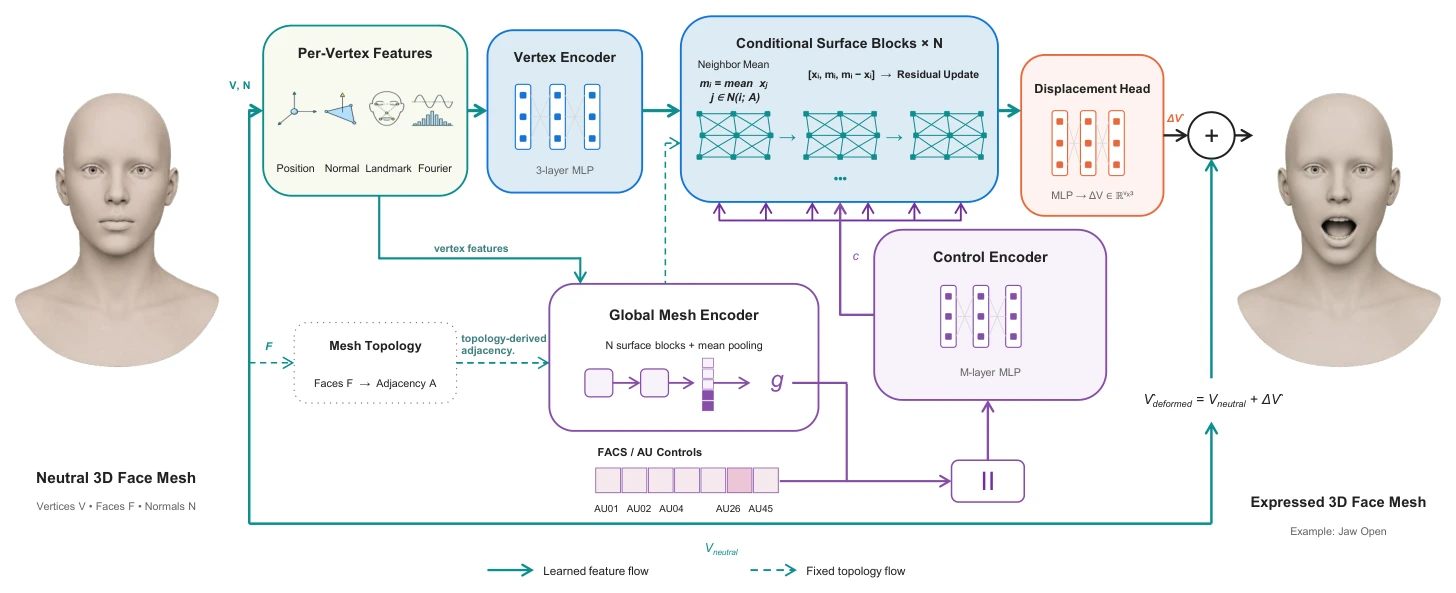
Local surface geometry, landmark-relative features, global shape context, and AU controls predict a displacement for every input vertex.
Vexpressed = Vneutral + ΔVTHE RESULTS
Evaluated on 350 held-out identities,
across shared and unseen mesh topologies.
Relative to the strongest evaluated baseline on identity-specific topologies.
0.274 mm MAE| Method | ICT | Pixal3D-100k | ||
|---|---|---|---|---|
| MAE ↓ | Q95 ↓ | MAE ↓ | Q95 ↓ | |
| NFS | 1.476 | 4.358 | 1.416 | 4.260 |
| NFR | 1.928 | 5.480 | 1.273 | 4.145 |
| TopoRig Ours | 0.400 | 1.257 | 0.274 | 0.975 |
Errors in mm; heads normalized to 240 mm height. Table 1 in the paper.
These errors measure agreement with reference expressions. Pixal3D references are automatically transferred rigs, so lower error measures transfer fidelity and topology generalization, rather than perceptual rig quality alone.
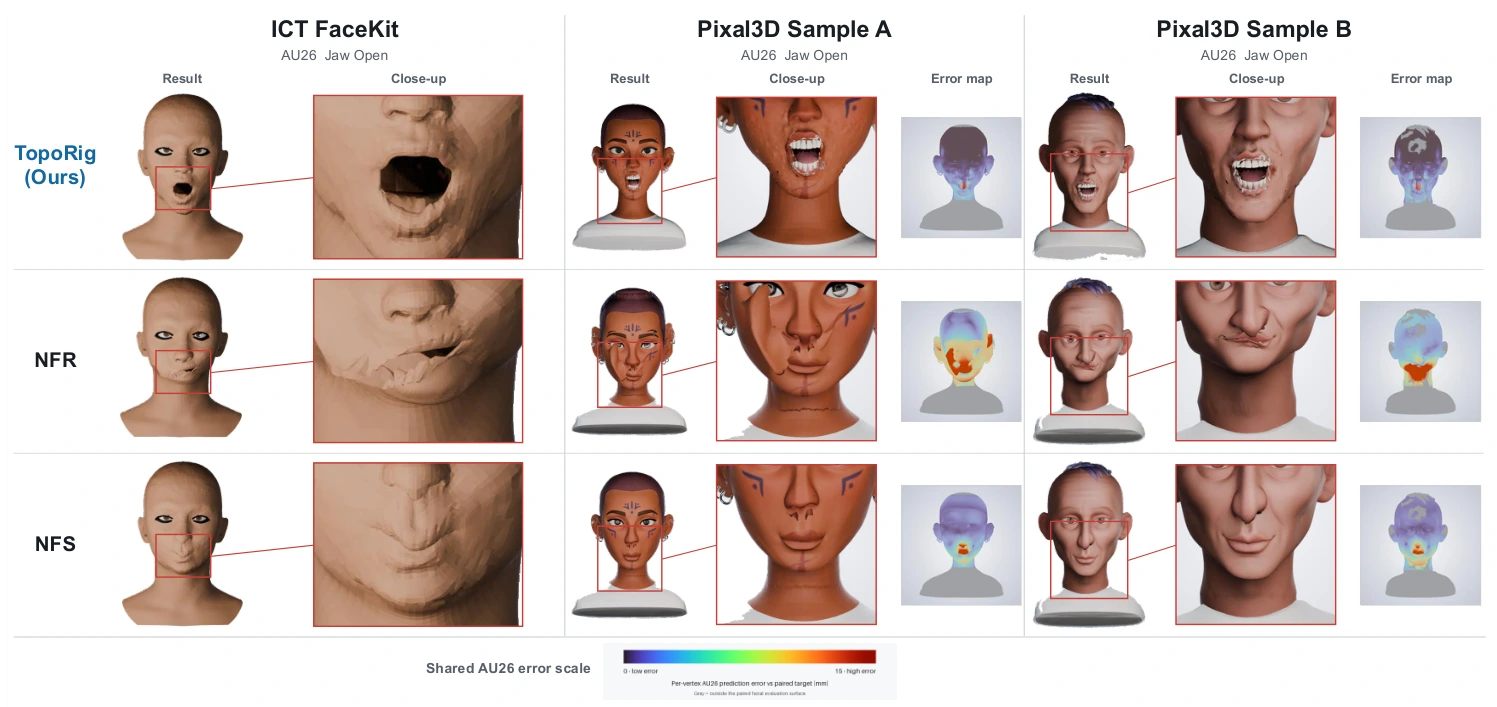
Jaw opening across the ICT template and two identity-specific topologies. TopoRig produces more consistent deformation than the evaluated baselines. Figure 4 from the paper.
PUBLICATION
Read the full method, evaluations, ablations,
and supplementary material in the paper.
Andrew Fleet, Soroush Mehraban, Vida Adeli,
Cole Clifford, and Babak Taati